







Best Restaurants
Exclusive Interview: Chef Daniel Boulud
October 14, 2026
By Margie Goldsmith
Influencing America’s Culinary Scene with French Techniques
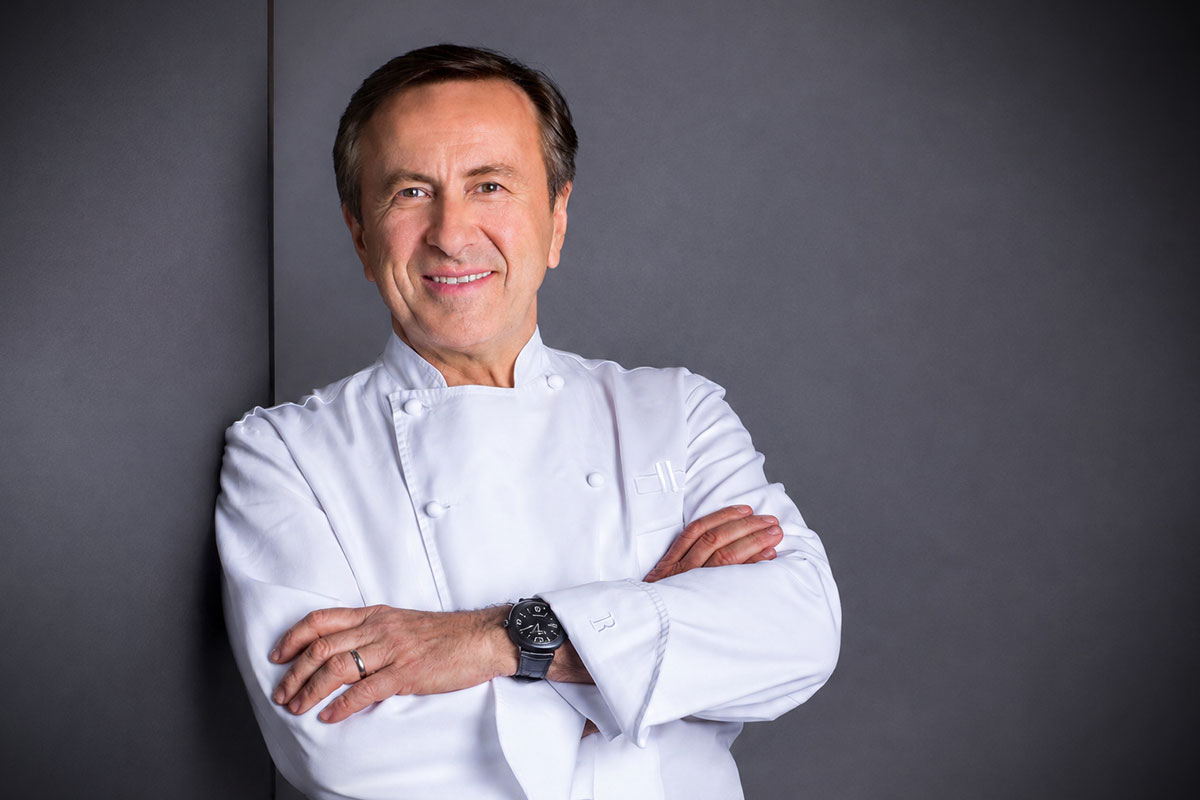
French-born Chef Daniel Boulud has a total of four Michelin stars for three of his restaurants in New York City: two for his flagship restaurant, DANIEL; one for Le Pavillon; and one for the omakase restaurant Jōji. The esteemed chef, whose cuisine is a contemporary evolution of soulful, classic French cooking, has 25 restaurants, including in the United States, Toronto, Montreal, The Bahamas, Singapore, Hong Kong, Dubai, and Riyadh.
Among his many accolades, he has multiple James Beard Foundation Awards (including Outstanding Chef and Best Chef: New York City), and the World’s 50 Best Restaurants Lifetime Achievement Award and Best Restaurateur in the World by Les Grandes Tables du Monde. He is on the board and co-president of City Meals on Wheels, for whom his restaurant DANIEL has raised around 20 million dollars over the last two decades. I caught up with the celebrated chef at his office in New York City.
Did you know as a child that cooking was what you planned to do with your life?
From the get-go. I grew up on a farm outside Lyon, and every day we cooked for a big family and the people working with us. At 14, I went to a cooking school, but the school, the teacher, and the food were all very bad, so I didn’t stay. My parents allowed me to do an apprenticeship, and I was placed in one of the best restaurants of Lyon under Chef Paul Bocuse [known as the “pope of gastronomy”].
What was the most important thing you learned from Bocuse?
To be myself. Paul promoted his name and French cuisine; I admired how humble and rooted he was in Lyon. When he traveled the world, he was not trying to bring some gimmick into his cuisine. He never tried to imitate anyone or try to be trendy; he respected tradition and believed you need to refer to the past in order to create something new.
So, you were in Lyon, home of so many famous chefs. Did you learn anything from them?
Yes. I had the chance to do many different stages, which is working three weeks here, a month there. I met all the greatest chefs of the time, and each had their own style of cuisine. Everyone had a different structure in the kitchen.
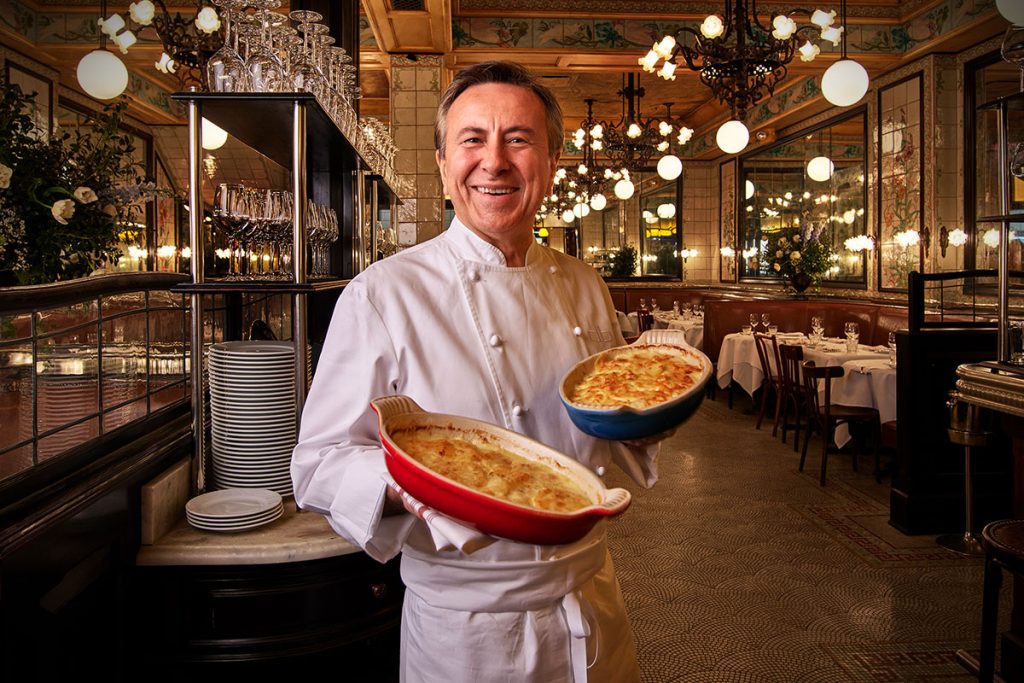
Photo by Bill Milne
You first came to America in 1981 to work as a private chef for an ambassador in Washington, D.C. A year later, you left for New York City to work at the Polo Lounge [at the Westbury Hotel] with Thomas Keller. What was that like?
We were both very young chefs. Keller was a meticulous, organized, disciplined, smart chef. In his kitchen, he didn’t want to be an American chef. He just wanted to be more French than American.
And you?
For me? I was French at that time. Now I’m a little bit more Americanized, but still not. I’ve always kept a very French kitchen everywhere.
Where did you go from the Polo Lounge?
After two years there, I became the executive chef of Le Régence at the newly opened NYC Hotel Plaza Athénée. I stayed two years, and by then I’d had enough of working in hotels. I wanted to work in a restaurant, not a restaurant in a hotel. But those four years gave me a platform to make a name for myself. Then I started at Le Cirque.
What was the most important thing you learned at Le Cirque?
I learned about managing a high-volume restaurant, about dealing with the daily work, but also creating a newsletter and writing a cookbook. I was doing catering on the side, all for the restaurant. I learned there was never a reason to say no to a customer, unless we didn’t have the product, and making the customer happy was something that always stayed with me. I learned the New York art of service – not America, not France, but New York, where the most powerful people in the world eat in the dining room. How do you keep everybody happy and keep them coming back? If we have the means to make somebody happy, then let’s make the customer happy. That is something that always stayed with me: the trust that Sirio Maccioni [restaurateur who opened Le Cirque and made it a headquarters for NYC’s rich and famous] put in his customers, and his sense of hospitality. And I learned that if you work hard, you’ll make it.
What do you find is the main difference between French and American cooking?
Today, there’s a blur between the two. France has always been driven by seasonality, markets, region, and gastronomy. Today, America also has a sense of seasonality and locality. We have wonderful farmers in America supplying great restaurants, which I don’t think existed in the ‘60s and ‘70s.
What’s the difference between American and French chefs?
In France, most of the chefs cook French cuisine. They are very creative and explore other cuisines, but they stay focused on what they’re best at. For an American chef, it depends on his background. If he’s Italian American, if he’s Korean American, Chinese American, Texas American, he will define his cuisine based on his DNA. I think diversity in cuisine is much wider in America because of the diversity of the talent. In the early ‘80s, we started to see kids coming from all backgrounds, and the CIA [The Culinary Institute of America] did a lot for that. There is this global exchange that didn’t really exist before. And that is all because Paul Bocuse created it.
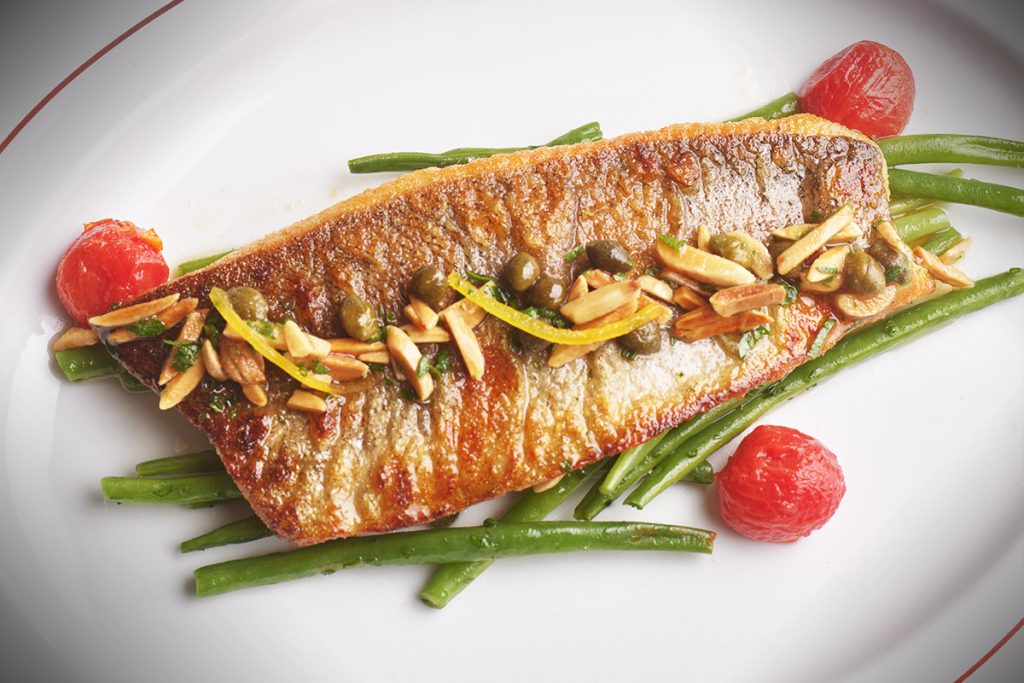
In 2021, you opened Le Pavillon, a Michelin-starred restaurant. Why a second fine dining restaurant when you already had Michelin-starred DANIEL?
Creating Le Pavillon was not to create a fine dining restaurant or to chase a Michelin star. It was to create a level of hospitality and dining in a unique setting where half of the restaurant is a garden. Everyone who comes here has been blown away by the place.
You have Jōji, which is also Michelin-starred, but it’s omakase. What made you decide to go in that direction?
I always wanted to do a small Japanese restaurant, and we came upon an opportunity to go into the basement of Grand Central and create a unique restaurant there. Jōji is definitely a three-star restaurant in a one-star setting, or a one-star rating with a three-star offering.
In 1998, you opened Café Boulud, also Michelin-starred, at Maison BARNES, in deference to your grandparents. Do you serve any of the same dishes they did?
No, because that was a century ago. But when I created the menu, it was also an opportunity for me to be a little bit more French American. I had four muses: to have a menu be about the classic French tradition; seasonality; le potage, because I grew up on a farm and garden and we ate vegetables all the time; and le voyage, exploring all the cuisine that is not French.
You introduced Blue Box Café by Daniel Boulud in Tiffany’s flagship store. It serves Breakfast at Tiffany’s, Tea at Tiffany’s – is this a proper English tea or the French version?
It’s a gorgeous and glamorous tea, a jewel, and a happy place where people go to celebrate anything. They go with their children, with their family; everybody dresses up, and there’s such an aura around the Tiffany brand.
Your contemporary French brasserie is opening opposite Lincoln Center. What is a contemporary French brasserie compared to a traditional French brasserie?
It’s a classic and contemporary brasserie that is definitely in New York. Thirty years from now it’ll be a little bit more classic, but today it is just a creation based on French design. There are always affordable things and a lot of choices on the menu. I think the only difference with a Parisian brasserie is that I may not have the ornate walls that certain brasseries associate themselves with.
Two years ago, you opened your first steakhouse, La Tète d’Or, a French-American steakhouse. What part of the steakhouse is French?
Many of my restaurants are French with a hint of American; this one is American with a hint of French.
What’s the hint of French?
First, I wanted to make sure that the quality of our meat was exceptional, different kinds of steak as well, not classic American. You can choose from eight or nine different sauces. If the French are known for one thing, it’s sauce. It takes a lot of wine, vegetables, and money to make a good sauce, and we don’t cut corners. So that’s the very French side of me. There’s also a great array of seafood and some modern dishes, and salads. Normally, you go to a steakhouse and you have Caesar and maybe one more salad; here we have six to eight salads from which to choose, plus a lot of appetizers that are a little more French.
I understand that you’re passionate about Chinese dumplings. Are you going to do a dumpling restaurant?
We just opened a restaurant called Terrace Boulevard in the heart of Hong Kong where we serve dim sum. One dim sum is from Lyon, made with a little bit of onion and truffle, almost like an onion soup and truffle dim sum. But every dim sum has a little bit of French je ne sais quoi.
What is your very favorite ingredient?
Depends. The humblest ingredient is garlic because I use it in everything. I grew up farming garlic and putting it on everything from our salads to roast chicken and fish. That’s my humble ingredient. My fancy ingredient is truffle.

Besides Brasserie Boulud, you plan to open a new restaurant in Costa Mesa, California. Why this location, and what kind of food?
Costa Mesa, near Newport, is one of the largest, most successful shopping malls south of L.A. Tiffany has a beautiful store there, and they’re creating a Blue Box Café, very much like the one in New York.
I understand you now have Cuisine Boulud New York, a new venture designed for corporate catering and special events.
For 30 years, I have taken great pride in catering events, mainly from the kitchen at restaurant DANIEL, helping to create some of the most joyful moments of our guests’ lives. As a team, we particularly enjoy bringing our sense of creative expertise to an industry that can often be seen as standardized. By elevating both the culinary and the hospitality elements of catering, Cuisine Boulud New York will truly stand apart.
How do you get to all of your 25 restaurants without becoming stressed out?
It’s not me. It’s the team. Like every business, we have a large team of executives. We train new people; we create a new relationship with suppliers, with farmers, and with local customers. It doesn’t matter which country or which city. It’s always an adventure, and I love adventure. If I didn’t like adventure, I would never have come to America.
You are a fit chef. Do you work out?
I try to work out, watch what I eat, and don’t drink too much. I appreciate a good wine, a good party once in a while, but not too much. I try to remain healthy and energetic.
What do you want your legacy to be?
I hope I will be known as inspiring. I’m not going to build myself a big statue, but I want to make sure that I am part of a culinary revolution in America that started in the ‘80s and continues for generations to come. I think my biggest legacy is my work as a French chef in America. I want to be sure that, as long as I live, I support the next generation and that I leave an imprint that outlives me. •
